
Mastering the Module 1 Test
Your Expert Guide for Brighton & Newhaven
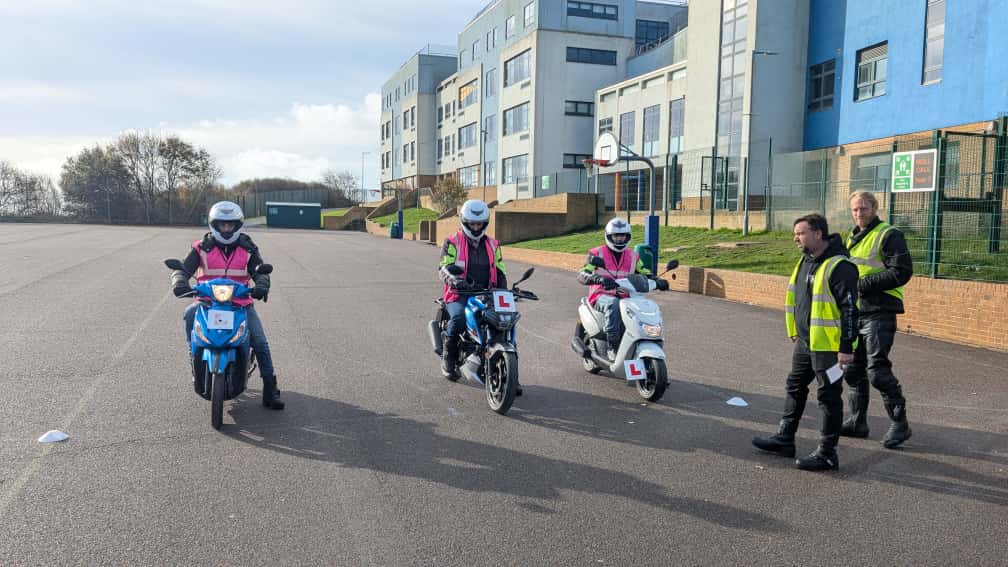
So, you've completed your CBT and now you're ready for the next challenge: the Module 1 motorcycle test. While it might seem intimidating, this off-road test is simply a way to prove you have complete control over your bike. Consequently, with the right training and practice, you'll find it's a challenge you are more than ready to meet.
Here at Alternative Motorcycle Training, we specialise in getting riders from Brighton, Newhaven, and the surrounding areas test-ready. This guide breaks down every single manoeuvre you'll face, giving you the knowledge and confidence to succeed.
What is the Module 1 Test?
The Module 1 test is a practical, off-road assessment of your motorcycle handling skills. It all takes place on a safe, purpose-built Motorcycle Manoeuvring Area (MMA), completely away from public roads and traffic. Essentially, the examiner needs to see that you can control the bike precisely at both low and high speeds before you can proceed to the on-road Module 2 test.
The Mod 1 Maneuvers: A Step-by-Step Breakdown
You will be asked to complete a series of specific exercises. Let's look at each one in detail.
1: Wheeling the Motorcycle
& Using the Stand
This is the first thing you'll do.
The examiner will ask you to wheel your bike from one cone box to another, demonstrating you can handle its weight. Afterwards, you'll be asked to put the bike on its stand and then take it off again.
2: Slalom and Figure of Eight
This exercise is all about slow-speed control and balance.
• First, you will ride in a slalom, weaving smoothly through a line of five cones.
• Immediately after, you will ride a figure of eight around two cones three times.
• The key here is to keep your speed low and steady, using gentle throttle, a touch of rear brake, and slight pressure on the handlebars (counter-steering). Above all, remember to keep your head up and look where you want to go.
3:The Slow Ride
Next, you'll be asked to ride as slowly as possible in a straight line, as if you were in slow-moving traffic.
The examiner will walk alongside you to assess your balance. Therefore, controlled use of the clutch and rear brake is vital.
• Slow-speed control and balance.
• Furthermore, you'll practice riding in a figure of eight and performing U-turns.
• Emergency braking.
Our instructors at our Brighton and Newhaven sites are experts at helping nervous riders build confidence. As a result, this stage is always taken at your own pace.
4: The U-Turn
This manoeuvre often worries learners, but it's straightforward with the right technique. You will be asked to perform a U-turn between two lines (representing a road) without touching either line or putting your feet down.
• To succeed, get a good observation in before you start.
• Then, keep the clutch at its biting point and maintain a constant, slow speed.
Crucially, turn your head 90 degrees and look exactly where you want to end up. The bike will follow your eyes.
5: Cornering and Controlled Stop
Now things get a little faster. You'll ride a curve and, as you exit, bring the bike to a controlled stop with the front wheel inside a designated box marked by four blue cones.
6: Cornering and Emergency Stop
This manoeuvre tests your ability to stop quickly but safely.
• You will ride the same curve, but this time you must reach a minimum speed of 50kph (approx. 32mph).
• As you straighten up, the examiner will signal for you to perform an emergency stop.
To do this, you must apply both the front and rear brakes firmly and progressively without locking the wheels.
7: Cornering and Hazard Avoidance
This is the final and fastest exercise, which also has a minimum speed requirement of 50kph (approx. 32mph).
• You will ride the curve again.
• This time, as you straighten up, you must swerve to avoid a "hazard" (represented by a cone) and then come to a controlled stop.
• The trick is a decisive push on the handlebars to initiate the swerve (counter-steering). For example, to swerve left, you push on the left handlebar.
Common Faults and How to Avoid Them
• Putting a foot down (U-Turn/Figure of Eight):
• Fix: Keep your speed from dropping too low and always look where you want to go, not at the ground.
• Missing the minimum speed (Emergency Stop/Hazard Avoidance):
• Fix: Be confident with the throttle coming out of the corner. Our instructors in Brighton and Newhaven will ensure you know exactly how much acceleration is needed.
• Poor observation:
• Fix: Make your head movements obvious before pulling away or starting the U-turn. A quick glance isn't enough; turn your head fully.
• Locking a wheel during the emergency stop:
• Fix: Practice braking with progressive pressure. Squeeze the front brake lever, don't grab it.

“Fantastic setup and plenty of space to practise – perfect for beginners in Brighton & Hove! ”
Frequently Asked Questions (FAQs) about Module 1
Click on each question to see the answer below
A: You must reach a minimum speed of 50kph (approx. 32mph) by the time you pass through the speed trap timing beams.
• If you do 48kph or 49kph: You will still pass, but you will get one "minor" rider fault.
• If you do less than 48kph: You will be asked to repeat the exercise. If you are too slow on the second attempt, unfortunately, you will fail.
• Don't worry about looking at your speedo—our training ensures you can hit this speed by feel and sound.
A: It depends on how it happens.
• A minor foot tap: If you put a foot down briefly to regain balance but keep the bike under control, it is usually recorded as a "minor" riding fault (you are allowed up to 5 minors).
• Loss of control: If putting your foot down suggests you have lost control of the machine, or if you "paddle" the bike around, this will likely be a "major" fault and result in a fail.
A: No. You must have a valid Module 1 pass certificate in your hand to take the Module 2 test.
• If you have booked both tests back-to-back (e.g., on the same day or consecutive days) and you fail Module 1, you will not be able to take Module 2 and you will lose the fee for that test. This is why we often recommend leaving a gap between the two tests.
A: The most common fails are surprisingly simple:
- Touching a cone: Hitting any cone during the slalom, figure of 8, or swerve is an automatic fail.
- Missed Observations: Forgetting to check your blind spot (lifesaver) before moving off or during the U-turn.
- Speed: Failing to reach the required 50kph on the high-speed exercises.
- Foot down: Losing balance during the slow-speed manoeuvres.
If you have any more questions, don’t hesitate to call us.
We look forward to riding with you!